
National Certifying Body for Infrared Professionals
 Get
Mold Certified Today
Get
Mold Certified Today  My Account
 800-679-4381
 Enroll
PROFESSIONAL MOLD INSPECTION INSTITUTE
Mold Inspector / Mold Remediator Training and Certification
 Regulations | FAQs | Tour
| Account800-679-4381
Enroll
Regulations | FAQs | Tour
| Account800-679-4381
Enroll
Level 1 Infrared Thermographer Course
Length: 60-Hours (Online) Fees: Sale $945
 This in-depth course is geared
towards those entering the infrared thermography field who may not have a background in science or engineering.
No experience in thermography is necessary, and no infrared camera is required.
This in-depth course is geared
towards those entering the infrared thermography field who may not have a background in science or engineering.
No experience in thermography is necessary, and no infrared camera is required.
The training begins with the fundamentals of physics and infrared energy in easy to understand language, and meets
Level I ASNT SNT-TC-1A recommendations for thermal/infrared testing, as established by the American Society for
Non-Destructive Testing (ASNT). After completing the course, you will receive a Level I Infrared Thermographer
Certification. Furthermore, you will possess the skills and knowledge necessary to begin your professional infrared
thermography career.
One of the few Level 1 thermography courses that can be completed entirely online, this course provides outstanding
infrared training for an excellent value. You will learn how to use an infrared camera for a variety of diagnostic,
monitoring, and predictive maintenance applications in commercial, industrial and building environments. The training
is accompanied by many examples, videos, and practice exercises to help you become familiar with the concepts.
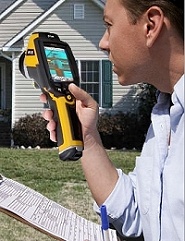 Collect quality
data, accurate temperature readings, and account for measurement effects such as distance and emissivity using
infrared cameras.
Collect quality
data, accurate temperature readings, and account for measurement effects such as distance and emissivity using
infrared cameras.
- Interpret thermograms and make informed decisions using heat transfer concepts to analyze thermal images
- Avoid the beginner mistakes that can damage your business
- Distinguish between hot spots and reflections, direct vs. indirect readings and qualitative vs. quantitative thermography.
- Challenging examples that simulate real-world infrared applications.
As you complete each lesson, you will use interactive flash cards and take practice quizzes that will test and
verify your knowledge simultaneously through instant online feedback. Your computer records the results so you
can easily track your progress.
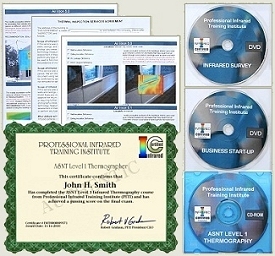
The course includes a DVD that takes you through a complete infrared property survey, and another DVD that contains
a quick-start guide for your infrared business. Other benefits include infrared survey report templates, pre-survey
agreements, and our toll free support to help you get started. When you finish the course and pass the final exam,
you will be a Certified ASNT Level 1 Thermographer and will possess the knowledge and skills needed to start a
full or part-time infrared business.
|
1. Physics Basics |
 An understanding of how
infrared radiation works
An understanding of how
infrared radiation works
How to accurately measure
surface temperature
Using an infrared camera
to its full potential
Avoiding the pitfalls
that affect new thermographers
How to complete a professional
thermal survey
And much more!
Package Includes:
Level 1 Infrared Thermographer Online Course and optional back-up materials on USB stick, Online Course Manual,
Infrared Survey Online DVD, Infrared Business Start-up Online DVD, Report Templates, ASNT-compliant Level 1 Thermographer
Certification, Toll Free Student Support.
Free Bonuses: $399 Infrared Inspection Report Creator, $149 InspectHost Business Website, $195 1-year National
Association of Infrared Surveyors Membership


30-Day Money-Back Guarantee
The only mold inspection and mold remediation training with a satisfaction guarantee!

©Professional Mold
Inspection Institute (PMII). All rights reserved.